
Americans Aren’t Saying ‘No’ to Data Centers; They’re Saying ‘Do It Right’
New data from Airedale by Modine reveals the practical conditions that turn neighbors into supporters
Americans aren’t rejecting data centers; they’re asking developers to do them right. Support for data centers hinges less on distance than on what facilities deliver to their communities. When presented with a choice between a data center one mile away that provides tangible benefits or one eight miles away that offers nothing, most Americans choose proximity with purpose.
Earlier this year, we published the Data Center Neighborhood Survey Report showing that 70% of Americans are comfortable with data centers within a few miles of their homes, and that most recognize these facilities as essential to maintaining U.S. competitiveness in technology and innovation. While that report revealed broad acceptance and general understanding of data centers’ role in the digital economy, it left open a crucial question: what specifically turns that general comfort into active support when facilities move closer to home?
To answer that question, we dug deeper into the survey conducted by the third-party platform Pollfish of 600 Americans aged 18 and older from March 7 to March 8, 2025. We found that the path forward is straightforward: lead with community benefits, address cooling noise, and design to local expectations. These are the silent rules behind acceptance, and the bar is both clear and practical.
Key Findings
- 63% would accept a data center within one mile if it improves internet reliability and brings jobs
- 49% wouldn’t sacrifice faster internet, stable power, jobs, or lower costs to avoid proximity
- Job creation drives the strongest support: 58% are very supportive when projects hire locally
- Tax benefits to the community generate 50% very supportive responses
- Quieter cooling technology would increase support for 62% of Americans
- 48% are very supportive when noise-reducing technology is employed
- 42% expect no impact on property values from a nearby facility
- Only 5% perceive data centers as extremely loud
Support comes with strings attached
Most people will live near a data center if it clearly helps them. 63% would accept one within one mile when it brings faster, more reliable internet and local jobs. At a national level, 72% say data center growth is necessary for the digital economy.
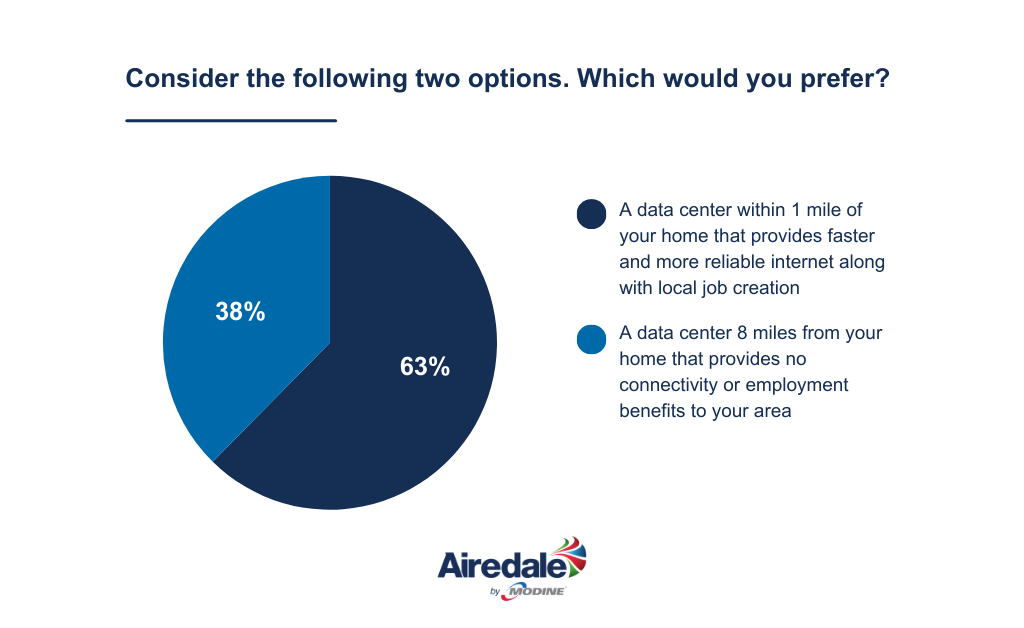 When push comes to shove, residents don’t want to give up those gains. 49% wouldn’t trade better internet, jobs, power stability, or lower costs just to avoid a nearby site.
The survey presented respondents with a direct choice: a data center within one mile that provides faster and more reliable internet along with local job creation, or a data center eight miles away that provides no connectivity or employment benefits. The closer facility with benefits won decisively (63% to 38%).
This preference holds even though one mile represents close proximity. The finding suggests that traditional “not in my backyard” resistance may be weakening when communities see clear returns on their acceptance.
Quieter data center cooling boosts public support
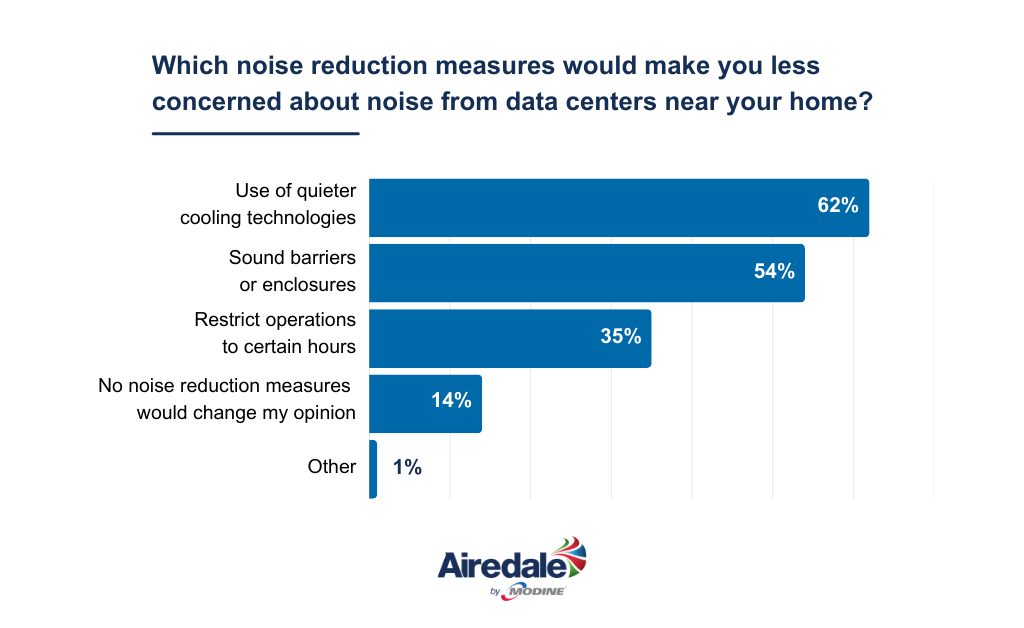
The public doesn’t see data centers as deafening. Only 5% think they’re extremely loud, on par with airports or highways. The largest share, 46%, compare them to the moderate sound of a running air conditioner. What does matter is equipment choice: 62% say quieter cooling technology would ease concerns.
High-intensity worry is limited. Just 9% are extremely concerned about cooling noise, while 32% are somewhat concerned and 32% are neutral. The concentration in the middle, 64% either somewhat concerned or neutral, represents persuadable opinion.
When asked which noise reduction measures would make them less concerned, quieter cooling technologies topped the list at 62%, followed by sound barriers or enclosures at 54%. Only 14% said no noise reduction measures would change their opinion, suggesting the vast majority are responsive to mitigation efforts.
Data center developments win when they pay locally
Clear benefits move people to strong support. 58% are very supportive if a project creates new jobs, and 50% are very supportive if it delivers tax benefits to the community. These numbers represent more than passive acceptance; they indicate residents who are likely to advocate publicly for projects and counter opposition.
Residents also connect data centers to everyday service quality: 38% first associate them with increased internet reliability, the top association among all options. This mental connection between data centers and improved infrastructure may help explain why communities are willing to accept proximity.
The survey tested support levels across multiple scenarios, revealing a clear hierarchy. Job creation generated the strongest response, with 58% very supportive and another 32% somewhat supportive; a combined 90% expressing at least some level of support. Tax benefits came next at 50% very supportive, followed by noise-reducing technology at 48% very supportive.
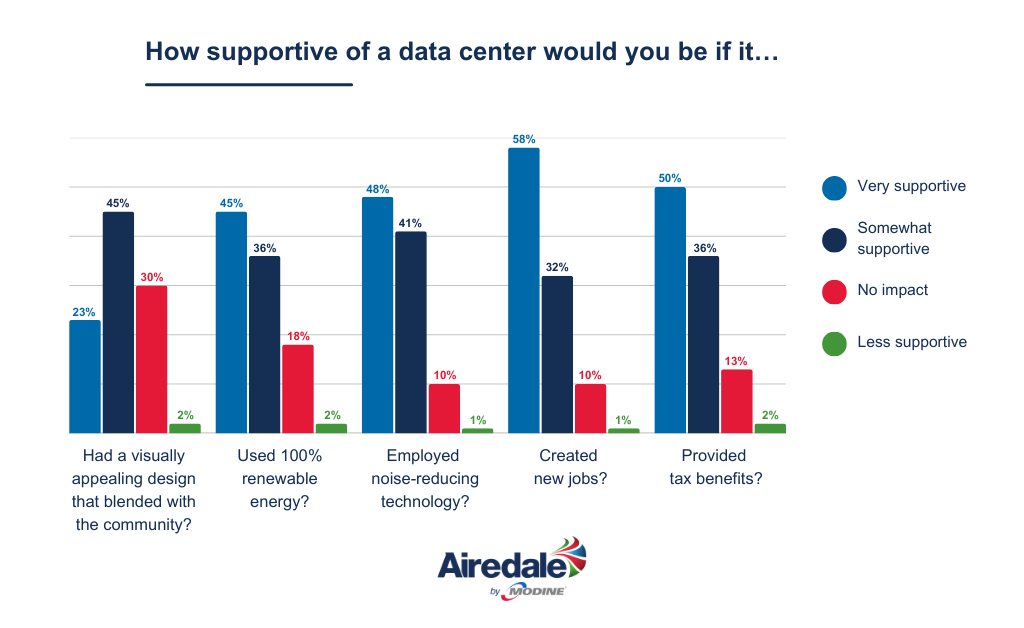
Renewable energy use generated 45% very supportive responses, while visually appealing design that blends with the community reached 23% very supportive. The pattern suggests residents prioritize tangible local value, though they appreciate multiple factors working in combination.
Build it to belong, and they’ll say yes
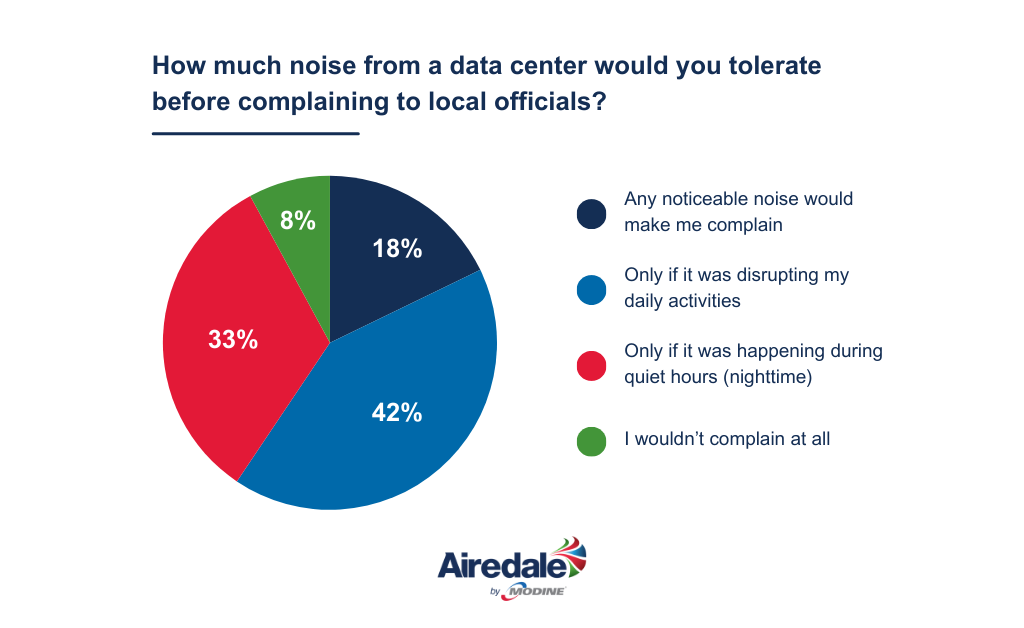
Looks and fit count. 23% are very supportive when the design blends with the community, and another 45% are somewhat supportive, a combined 68% positive response. People also set clear boundaries on sound: 33% would complain only during quiet hours, and 42% only if noise disrupts daily life.
 Information still helps. 21% say they don’t know enough about data centers, a gap which more straightforward project explanations can help close.
Tolerance thresholds reveal practical boundaries. Only 18% would complain about any noticeable noise. The majority set context-dependent limits: 42% would complain only if noise disrupted their daily activities, while 33% would complain only during nighttime quiet hours. 8% say they wouldn’t complain at all.
Confidence in property values holds strong near data centers
For many, a nearby data center isn’t a deal-breaker on housing. 42% expect no impact on property values. Some even expect upside: 18% foresee an increase: 5% significant and 13% slight.
Where people see a drop, it’s usually small. 31% expect only a slight decrease, while larger drops are far less common. Just 10% expect a significant decrease.
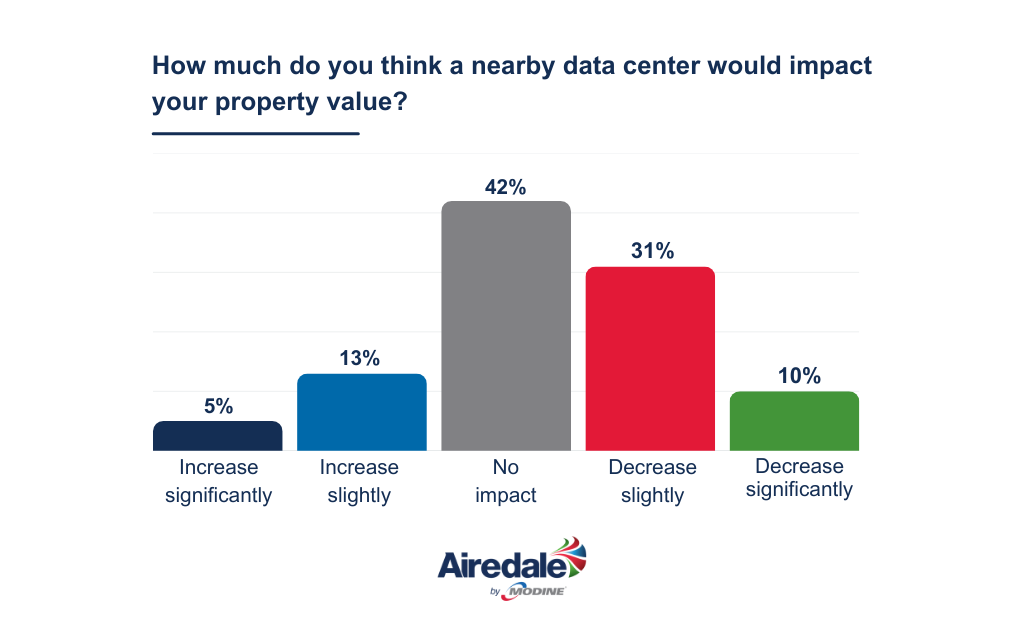
Combined, 60% of respondents expect property values to either hold steady or increase with a nearby data center, compared to 41% who anticipate declines. Among those expecting negative impacts, modest effects outnumber significant ones by a 3-to-1 margin.
This challenges a common assumption in infrastructure debates: that industrial development automatically depresses residential property values. The data suggests property value concerns, while real for some residents, may be less of a barrier to acceptance than developers often assume.
The blueprint for acceptance
The research reveals a clear hierarchy of what moves communities from resistance to support. Economic benefits anchor acceptance, with job creation and tax revenue generating the strongest positive responses. Cooling technology choices matter more than general noise concerns, offering developers a specific and actionable path forward.
Property value fears affect a minority and are generally modest. Visual integration helps smooth the path but functions as a secondary consideration. The data makes one thing clear: communities aren’t asking for data centers to go away; they’re asking for them to contribute.
For data center operators facing surging demand, this represents both a mandate and an opportunity. Meeting community expectations requires infrastructure that performs efficiently while minimizing environmental impact. Advanced cooling solutions play a decisive role: high-efficiency air and liquid cooling systems, heat-reuse capabilities, free-cooling strategies, low-GWP refrigerants, and intelligent controls can dramatically reduce energy and water consumption while maintaining uptime and supporting higher rack densities.
Airedale by Modine is built for this moment. The company’s portfolio focuses on reducing cooling energy at scale, optimizing for PUE and WUE, and instrumenting systems so improvements are measurable and auditable. This combination—efficient hardware, intelligent controls, and verifiable data—transforms infrastructure upgrades into proof points that operators can communicate to communities and stakeholders.
“The path to community acceptance is clear: deliver economic value, minimize disruption, and prove it,” said John Williams, Group Vice President – Americas DC, Airedale by Modine. “Our role is to give data center operators the tools to meet those expectations. By reducing the cooling footprint and providing transparent metrics, we help operators expand capacity responsibly, turning conditional support into lasting partnerships with the communities they serve.”